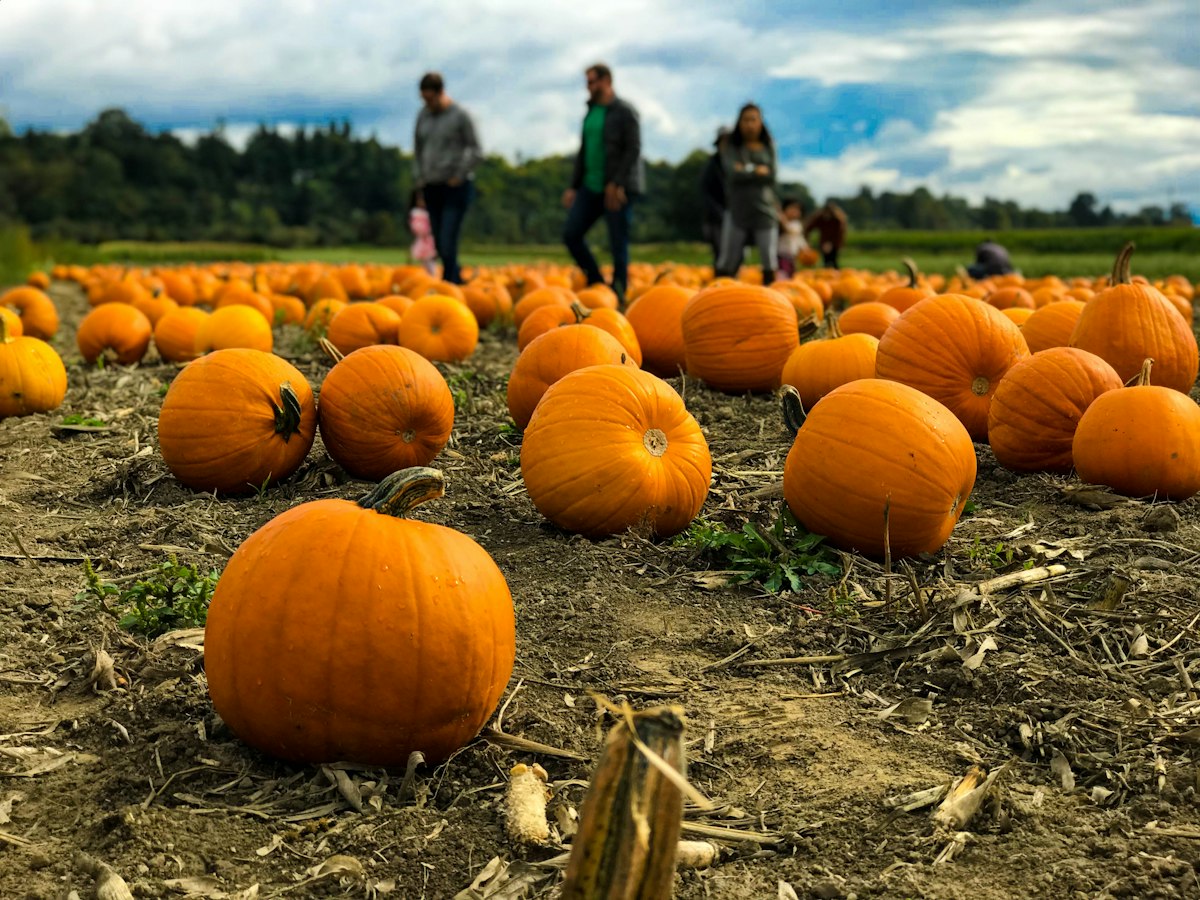
In October 2025, Floridians typed "pumpkin patch near me" into Google 301,000 times. In February 2026, they typed it 210 times. Same state, same phrase, a 1,400-fold swing between the two months. We pulled those numbers from Google's own Keyword Planner on September 8, 2026, filtered to Florida. They describe the single hardest problem in farm marketing, and almost nobody plans around it: the demand for your farm as a place to visit arrives in a four-week window, and by the time it arrives, it is too late to earn a position in it.
The math
Here is the full twelve-month shape of that one query in Florida, month by month:
- August 2025 — 5,400
- September 2025 — 40,500
- October 2025 — 301,000
- November 2025 — 22,200
- December 2025 — 720
- January through July 2026 — between 210 and 590 a month
Google reports the annual average as 33,100 a month with LOW competition. That average is a lie of arithmetic. Ninety percent of the year's searches land in a single month, and the ramp begins in September — the month you are reading this in.
The pattern repeats across every visit-driven query a Florida farm could want, on different calendars:
- "corn maze near me" — 22,200 in October, 90 in June.
- "blueberry picking near me" — 18,100 in April, 12,100 in May, 390 in December.
- "strawberry picking near me" — 12,100 in January and again in March, 1,000 in July.
- "petting zoo near me" — 12,100 a month, and remarkably flat all year. This is the exception, and it matters: it is the one that pays rent in the off-season.
Every one of those clusters is marked LOW competition in Florida. Nobody is bidding on them because nobody has built anything to rank with them.
The money is real and growing. The USDA Economic Research Service, working from the 2022 Census of Agriculture, put U.S. farm income from agritourism at $1.26 billion — up 12.4 percent from 2017 after adjusting for inflation. Fifty-seven percent of American counties reported agritourism income, with a median of $161,000 per county. Agritourism is no longer a side table at the farm stand. It is a second business, and it is discovered almost entirely through search and maps.
Why Florida farms specifically
Three things make this sharper here than anywhere else.
Our calendar is inverted. National agritourism advice is written for a September-to-November harvest. Florida's biggest u-pick seasons are the ones the rest of the country is asleep for: strawberries from December through March around Plant City, blueberries in April and May from Alachua County down through the ridge. Which means a Florida grower who copies a Midwestern content calendar publishes the right page in exactly the wrong month. The blueberry page has to be indexed and ranking by February to catch April.
The law is unusually friendly, and most growers don't use it. Florida Statutes §570.86 defines an agritourism activity broadly — viewing or enjoying farming and ranching, historical, cultural, educational, exhibition and harvest-your-own activities. §570.85 bars a local government from adopting or enforcing an ordinance that prohibits, restricts or limits agritourism activity on land classified as agricultural under §193.461, with an exception preserved for substantial offsite impacts and emergencies. Growers in Hernando, Pasco and the Loxahatchee area routinely assume opening the gate to the public is a zoning fight. Often it isn't. That's a conversation for your own attorney, not for us — but the statute is worth reading before you decide the answer is no.
Your visitor is not from here. A Gainesville u-pick draws students and young families. A Homestead grove draws Miami-Dade day-trippers who will search in Spanish half the time and drive fifty minutes on a Saturday. Neither of them knows your farm's name. They know the thing they want to do. That is the entire strategic point: they search the activity, not the farm.
The playbook
1. Give each season a permanent address
The most common mistake is running the season out of a Facebook event. The event is created in September, dies in November, and takes all its accumulated authority with it. Next year you start from zero.
Instead, build one page per activity that lives at the same URL forever: /u-pick-blueberries/, /pumpkin-patch/, /farm-tours/. In the off-season the page stays up and says clearly when the season opens and what it costs. Every year it gets updated, not replaced. Year two it ranks better than year one, because Google has watched that URL answer the same question for eighteen months. A page rebuilt annually never accrues anything.
2. Fix the Google profile before the gate opens, not after
Your Business Profile is doing more work than your website in these searches, because most of them are map searches. Three settings matter and most farms have none of them set:
- Secondary categories. A farm listed only as "Farm" will not surface for "pumpkin patch near me." Add the categories that match what you actually run — Pumpkin Patch, Petting Zoo, Farmstead, Tourist Attraction — as secondaries. The primary category stays what you are; the secondaries are how you are found.
- Seasonal hours, set in advance. Google supports "more hours" and special hours. A farm that is open Fridays through Sundays in October and closed the rest of the year should say so on the profile in September, not discover on opening weekend that Maps still shows Monday-to-Friday.
- Attributes people filter by. Restroom, family-friendly, wheelchair access, on-site parking, dogs allowed, credit cards accepted. These are filters in Maps. Missing ones don't just look incomplete — they remove you from filtered results entirely.
3. Publish the dates six weeks early
Google has to crawl, index and then decide whether to trust a page before it will rank it. That takes weeks, and you do not have weeks in October. September's 40,500 searches are the tell: people are planning three to four weeks out.
Practical rule: the page for a season goes live, with real dates and real prices, six weeks before opening day. For a Florida pumpkin patch that means mid-September. For blueberries in April, it means late February. Post the announcement on the Business Profile the same week — a profile post is one of the few things Google surfaces almost immediately.
4. Answer the question the way an AI will read it
Increasingly the person planning a Saturday asks an assistant instead of a search box: "where can I take a four-year-old to pick strawberries near Gainesville, and how much is it?" A model answering that pulls from text it can parse. It cannot infer your admission price from a poster in a Facebook photo.
Put the following on the page as plain text, in sentences, not as a graphic: admission price and what it includes, whether picking is by the pound or by the bucket, minimum age or height for any ride, parking, restrooms, whether you take cards, whether dogs are welcome, and how long a typical visit takes. Then mark the same content up as FAQ schema. Farms lose more of these queries to missing prices than to anything else.
5. Harvest the reviews while the crowd is standing there
The season is short and so is your review window. A farm that collects forty reviews in six weeks looks alive; the same farm collecting forty across a year looks the same on paper and ranks worse, because recency is weighted. Put a printed QR code at the checkout table and at the wagon queue, and have whoever runs the register ask once per family. Six weeks of that is worth more than any other single thing on this list.
What good looks like
A seasonal page that works. Title: "U-Pick Blueberries in Alachua County — 2026 Season." First paragraph states the opening date, the closing estimate, the price per pound, and the hours. Then a short section on what to bring. Then the FAQ block. Then a map embed and driving directions from the two nearest towns by name. Nothing decorative above the price.
A Business Profile post, published mid-September:
Pumpkin patch opens Saturday, October 3. Open Fri–Sun, 9am–5pm through October 31. $8 per person, under 3 free, includes the hayride. Field is stroller-friendly and we take cards. Parking on site off CR-241.
That is 200 characters doing more work than a season of photo posts, because it contains the four facts every one of those 301,000 searches is actually trying to resolve: when, how much, what's included, can I park.
An off-season move. Look again at "petting zoo near me" — 12,100 a month in Florida, every month, barely moving. Farms with animals and a fence have a year-round query sitting unclaimed while they fight over four weeks in October. School field trips, birthday parties and weekday morning visits all live in that flat line. It is the least glamorous number in this article and probably the most valuable.
Where to start
If your October page isn't live yet, that is this week's job — the ramp has already started and the searches in the list above are happening now. If it is live, the next check is whether your Business Profile categories, seasonal hours and attributes match what the page promises, because the map result is what most people will actually see.
We do this as a free five-page audit, 48 hours, no sales call. We look at how your farm currently surfaces for the activity searches in your county, what your profile is missing, and which season you are closest to being ready for. Request the audit here.
Search volumes in this article were pulled from Google Ads Keyword Planner on September 8, 2026, geo-targeted to Florida. Agritourism income figures are from the USDA Economic Research Service analysis of the 2022 Census of Agriculture. Statutory references are to Florida Statutes §§570.85–570.89 and §193.461 and are provided as background, not legal advice.