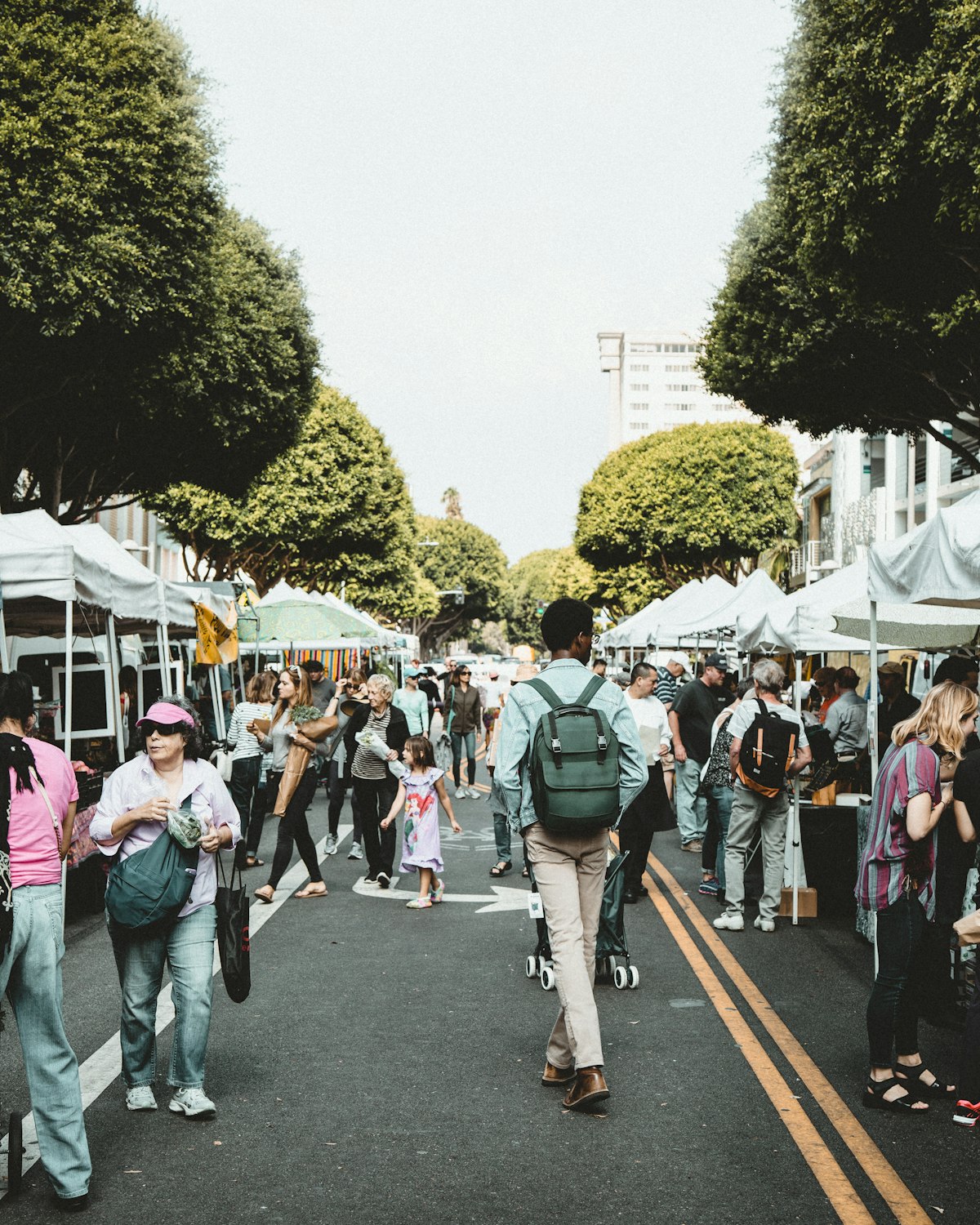
Every month in Florida, roughly 60,500 people type "farmers market near me" into Google. Another 27,100 search "markets near me," 2,400 want to know which market is open today, and 1,300 specifically ask about Sunday. Almost every one of those searches ends at a market — a parking lot, a downtown block, a pavilion with a name and an address. Almost none of them ends at a grower. The farm that drove ninety minutes to set up table nine is, to Google, not there at all.
That is the gap this playbook closes. Not how to sell more at the stall — how to exist in the search that sends people to the stall in the first place.
The math
We measured the demand ourselves with Google's Keyword Planner, geo-targeted to Florida, on September 22, 2026. The cluster looks like this:
- farmers market near me — 60,500 a month, low competition
- markets near me — 27,100
- fruit stand near me — 3,600
- farm store near me — 3,600
- farm stand near me — 2,400
- farmers market near me today — 2,400
- produce stand near me — 1,900
- local honey near me — 1,900
- sunday farmers market near me — 1,300
- local farm near me — 1,300
Call it 106,000 searches a month in this state alone, and the headline term carries the lowest competition rating Google assigns.
The month-by-month breakdown matters more than the average. "Farmers market near me" ran 60,500 in September, 49,500 in December, 74,000 in January, 74,000 in August. There is no off-season. Compare that to the agritourism demand we measured two weeks ago, where "pumpkin patch near me" hit 301,000 searches in October and 210 in February. Agritourism is a spike you sprint to catch. Market demand is a floor you can stand on all year — which means the work you do once keeps paying in March, in July, in November.
"Farm stand near me" even runs backwards from what you would guess: 1,300 in December, 3,600 in August. Floridians look for a roadside stand hardest in the month the rest of the country calls dead.
Why Florida growers specifically
Three things make this state's version of the problem sharper.
The stall is the whole storefront. A beekeeper in Alachua County, a produce grower outside Homestead, a specialty food maker in Broward — most sell at three or four markets a week and nowhere else. There is no shop with a door. The only place a customer has ever seen the brand is a folding table under a ten-by-ten canopy, and that table belongs to somebody else's address.
Our market calendar is inverted. South Florida's outdoor market season runs roughly November through April, when the rest of the country has shut down. Growers who set their online presence to a national rhythm end up marked "closed" in the exact months they are busiest, and cheerfully "open" in August when the canopy is in the barn.
The market outranks you on your own name. Search a well-known market in Coral Gables or Gainesville and you get the market's profile, the market's photos, the market's reviews, the market's hours. Search the farm that sells there and you frequently get nothing — or a Facebook page from 2019. The market spent years building that profile. You are a line item on its vendor page, if you are on it at all.
The playbook
Step 1 — Claim a Business Profile without an address
This is where most growers stop, because they believe a business with no shop cannot have a listing. The opposite is true, and Google is explicit about it. From the service-area guidelines: "If your business doesn't have permanent on-site signage, it's not eligible as a storefront and should be listed as a service-area business." A canopy you fold up at two o'clock is not permanent signage. Neither is the market's address, which belongs to the market.
So: create one profile for the farm, set the business address to your actual operating location, then hide it and define a service area instead. Google's guidance for anyone who does not receive customers at their address is to remove the address from the profile entirely. You can set up to twenty service areas by city or postal code — Miami-Dade, Broward, and Palm Beach cities, or the counties you actually drive to. Google notes the outer boundary should not run more than about two hours' drive from where the business is based, and that a service area cannot be drawn as a radius.
One profile. Not one per market. The guidelines allow a single service-area profile for the whole area you serve, and duplicates get suspended.
Step 2 — Build the page the market will never build for you
The market publishes its own hours. Nobody publishes your schedule — which markets, which days, which table. Put that on one URL on your own site and keep it current: a plain list of every market you attend, day of week, hours, city, and what you bring to each one.
This page is the answer to "farmers market near me today," and it is the answer an AI assistant can actually read and repeat when someone asks where to buy local honey in Gainesville this weekend. Mark it up with structured data — Event for each market day, LocalBusiness for the farm — so the schedule is machine-readable rather than a photo of a flyer. Do not count on rich results; count on being the only source in the county that states the answer in plain text.
Link it from the profile as your main website or as a secondary link, and link it from every social bio. One page, one job.
Step 3 — Get listed as a vendor everywhere the market is listed
Most Florida markets keep a vendor page, and most vendor pages are a list of names with no links. Ask for a link. Ask for the farm name spelled exactly as it appears on your profile, the same phone number, the same city. Those three details in agreement across a dozen small directories are what tells Google two mentions are the same business.
Then work outward: the USDA National Farmers Market Directory, county extension listings, Fresh From Florida, the tourism site for your county, any "where to buy local" roundup a neighbor has written. Each one is a citation, and citations are the raw material of a service-area business with no storefront to point at.
Step 4 — Set seasonal hours honestly, and close in the off-season
Google's guidance on seasonal hours is short and almost nobody follows it: during the season you are open, set your regular hours of operation, and you may indicate the seasonal period in your business description. In the off-season, mark the profile as temporarily closed, then restore regular hours when you reopen.
For a market vendor that translates directly. Your hours are your market hours — Saturday 9 to 1, Wednesday 3 to 7 — not "Mon–Fri 9–5," which is the default most people accept and which is false every day of the week. When the season ends in May, temporarily closed is the honest signal, and it protects you from the review that says "drove out, nobody there." Restoring hours in November takes two minutes.
Step 5 — Post the week, every week
A Google post is a free slot most growers never use. Once a week, on the day before your biggest market, publish one: which market, which hours, what is ready this week. Forty words and one real photo taken at the table.
Two reasons this beats posting on Instagram alone. It answers the "today" and "Sunday" versions of the search, which are 3,700 searches a month in Florida on their own. And it gives a profile with no address something no algorithm can fake: evidence, every seven days, that a real business is operating.
What good looks like
The profile. Name: the farm's real name, nothing else — no "at Coral Gables Market," no city tacked on. Google's naming rules prohibit location and containment information in the name, and that rule is enforced by suspension. Category: the most specific one that completes "this business is a" — produce farm, honey farm, farm shop — never the market's own category. Address: hidden. Service area: the cities you sell in.
The schedule page. One heading per market, five lines each:
Saturdays, 9 a.m.–1 p.m. — Coral Gables Farmers Market, Merrick Park. Look for the blue canopy at the north end. Raw orange blossom honey, comb honey, beeswax candles. From November 1 through April 25.
The weekly post. "Wednesday market in Gainesville this week, 3–7. Bringing the last of the summer honey and the first sourwood. Corner spot by the fountain." Photo of the table. Done in ninety seconds while the truck is loading.
Start with the audit
The thing to understand about this work is that it is almost entirely one-time. The profile is set up once. The schedule page is written once and edited when a market changes. The citations are built over a few evenings. After that it is one post a week and an hours change twice a year — against a demand curve that does not drop below 49,500 searches a month in this state.
If you want to know where your farm currently stands in that search, we will tell you: a free five-page audit, 48 hours, no sales call. We look at your profile, your citations, your site, and what the markets you sell at are publishing about you — and we send back what is missing, in order of what it costs you.